


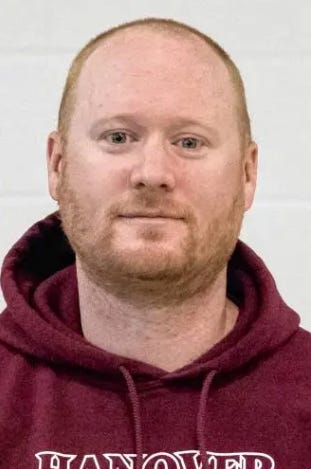
HANOVER, N.H. — The commute begins at 7:42 a.m.
He emerges from the home office, a room that is legally a law practice and functionally a place where a man can keep a printer and avoid people. From there it is roughly the length of a hallway to the front door. Ryan Gardner covers that distance in a little under four minutes. There is no hurry in it. There is no urgency. There is only the slow, deliberate, gyroscopic transfer of weight from one hip to the other that his colleagues have described, generously, as walking, and that his wife has described, accurately, as waddling.
“He calls it a commute,” says Helena Gardner, who has been married to him long enough to have developed a completely flat delivery. “It’s twenty feet. He’s passed the coffee maker twice.”
Ryan Gardner is in his forties. It is worth establishing this early, because almost nothing else in this article will confirm it.
THE REGIMEN
Under the desk in the home office, there is a Rygeo Pedal Exerciser.
It is a small plastic device with two pedals, a tension knob, and a tiny display reporting numbers that no independent party has ever verified. It costs about forty dollars. It is, as best anyone can determine, the entirety of Ryan Gardner’s athletic infrastructure.
He pedals during client calls. He pedals while reviewing film. He pedals while composing emails to the athletic director that he does not send. On a good day he will announce to the room that he “got a solid twenty in,” declining to specify twenty of what.
The tension knob goes from one to eight.
“It has never been above two,” Helena says. “I’ve checked. Many times.”
THE CREDENTIAL
Ryan Gardner went to Princeton.
You will not learn this from Ryan Gardner. It arrives sideways, from somebody else, in a parking lot, years into knowing him, and your first reaction is that you have misheard.
Hanover is not a town short on credentials. This is a place where you cannot back out of a parking space without endangering a published academic. There are more advanced degrees per square mile here than almost anywhere in New England — and the smartest man in the zip code has not been photographed in a collared shirt since the Bush administration.
Not a dress shirt. Not a polo. Not a tie, obviously; the tie is a bridge several towns too far. He practices law in a quarter-zip. He has taken positions of real consequence while wearing a fleece that has been washed so many times it has changed genus. When an occasion demands better — an occasion he cannot get out of — something gets worked out, quietly, at the last minute, and nobody discusses it afterward.
The mind is legitimately frightening. He will take an argument apart in about nine seconds while wearing gym shorts in forty degree weather. He remembers everything. He reads constantly. He can hold four unrelated things in his head and locate the one place where they touch.
And he will deploy every bit of that horsepower, the entire Princeton apparatus, to explain to a nineteen-year-old official why that was, by rule, a legal push from behind.
THE POSITION
The arc of Ryan Gardner’s coaching career is best understood as a man trying to quit smoking.
He started as an assistant. He was good at it. He was good enough at it that eventually they handed him the whole thing, and for a handful of years Ryan Gardner was the head coach of Hanover High School boys varsity lacrosse. The chair. The clipboard. The postgame remarks. The 11:40 p.m. emails from a father named Doug.
Then he quit.
Nobody pushed him, and this should be said plainly, because the other version of the story is funnier and completely untrue. He walked away on his own terms. He cited bandwidth and the practice and time with the family, and everyone nodded, because those are real reasons and he had real versions of all three.
He lasted about as long as you would expect.
Because here is the thing no amount of bandwidth can fix: Ryan Gardner loves coaching. Not likes. Not “enjoys giving back.” Loves it, in the specific and faintly alarming way a person loves a thing they cannot be talked out of. He came back as an assistant, an arrangement he now describes as the best years of his coaching life, and here he is telling the truth. He gets every opinion he had as head coach and none of the paperwork. He is a former head of state who still turns up to the briefings. He does not answer to Doug. He simply stands eleven feet from the decision-making and reacts to it, visibly, at volume, for two hours.
THE BUS
The team travels by bus. Ryan does not.
The bus is a functional yellow vehicle with seats, windows, and a driver named Dale who has never once complained. Ryan refers to it exclusively as “the short bus,” a nickname he finds hilarious and has found hilarious continuously since approximately 2001, and which no one else has ever laughed at, including in 2001.
He follows the team in his own car at a respectful distance, like a Secret Service detail nobody requested. He arrives four minutes after everyone else. He parks close. He gets out holding a coffee he did not need and cannot finish, and he walks toward the field with the bearing of a man who has just landed in a helicopter.
“He says it’s about back support,” Helena says. “It’s about the radio.”
THE OFFICIATING
Coaches yell. Every coach yells. Yelling at officials is a well-established part of the sport and, in some counties, a form of local theater.
Ryan does not yell. Ryan conducts.
It begins in the first quarter as commentary, delivered at conversational volume to no one in particular, on the general decline of American officiating. By halftime it has become a personal correspondence between him and one specific man in stripes. By the fourth quarter he is out on the white line with both arms open, palms up, explaining the rulebook to a 72 year-old getting paid sixty-five dollars to be there.
And then there is a hand on his elbow.
Helena has, over the years, developed a technique. She does not scold. She does not argue. She simply appears, takes the arm, and applies steady lateral pressure, the way you would guide a shopping cart with a bad wheel. Witnesses describe it as almost tender. It works every time. He is still talking as he goes, but he goes.
She has extracted him from an estimated forty games. She has never once had to say anything.
THE RITUAL
After a bad practice — and there is always a bad practice — it becomes Miller Time.
He says this out loud. He says it as though the phrase is his, as though he has just now arrived at it, and he has been saying it since before some of his players were born.
Let it be stated plainly, for the record, without hedging: the man loves Miller Lite. Not tolerates. Not defaults to. Loves. He has been offered other beers. Good beers. Expensive beers. Beers brewed eleven miles from his house by a man with a beard and a philosophy. He declines them the way a happily married man declines a phone number. He will hold forth on the failures of the modern IPA for six unbroken minutes, unprompted, holding a Miller Lite, and at no point in those six minutes will he detect any tension in this.
Press him and he will go to the mat. Great taste. Less filling. He is aware that this was an advertising campaign. He is aware that it ran before he was born. He considers the matter settled and the argument won.
The ceremony has a location, and the location is Ramunto’s. Small. Loud enough. Pizza on one side, beer on the other, no pretense anywhere in the building. Ryan does not go to Ramunto’s so much as return to it. There is a seat. It is understood to be his seat — not by any formal arrangement, but by the same unwritten municipal logic that governs pews and barber chairs — and on the rare evening somebody else is in it, the entire room can feel the disturbance.
He arrives in the practice clothes. He does not go home and change first, because changing first would imply the day is over, and the day is not over until the debrief is done. The debrief happens here, at length, delivered to whoever is present, regardless of whether that person coaches, played, or has ever in their life seen a lacrosse game.
Then he sits. There is a long exhale that sounds like a tire deflating in a distant town. The first pull is taken with the eyes closed, and it converts whatever happened out on that field into something a man can live with.
He has been known to observe Miller Time after good practices too. For balance.
He brings his own to cookouts, to team dinners, to other people’s homes. Not because he thinks the host won’t have beer. Because he knows the host won’t have this.
THE SIGHTINGS
Ryan Gardner is everywhere.
This is not a figure of speech so much as a logistics problem. There is a growing body of evidence that he is either in two places at once or has quietly eliminated sleep as a category.
Tuesday evening — location undisclosed. Choir practice. There is no choir. There is no singing. It is a standing engagement with a group of men, most of them comfortably north of seventy, who drink together and have for years and who call it choir practice because that is funnier and because at some point one of them needed to tell a wife something. Ryan is the youngest man in the room by roughly thirty years. He does not find this concerning. He finds it an honor. He has never missed one.
Thursday, 6:15 p.m. — Norwich. The racket club. Ryan is there. He is playing, or he is watching, or he is standing near a court holding a Miller Lite that he has been permitted to bring in, an exemption that has never been fully explained and that no other member appears to enjoy. Asked about the arrangement, he says only that he “worked it out with them.”
Saturday morning — Lebanon. A sporting event. The sport is not the point; the sport rotates. Middle school basketball, a wrestling meet, a JV game between two programs with no bearing on anything. Ryan is in the third row. He has no kid on either team. He has no kid at either school. He has, as far as anyone has been able to establish, no reason to be in the building at all. He knows the score, the substitution pattern, and which kid has been playing on a bad ankle since the second week of the season.
And when nobody can find him anywhere, which does happen, he is at home at the desk with four or five windows open, watching Division II and Division III lacrosse streams of a quality best described as available.
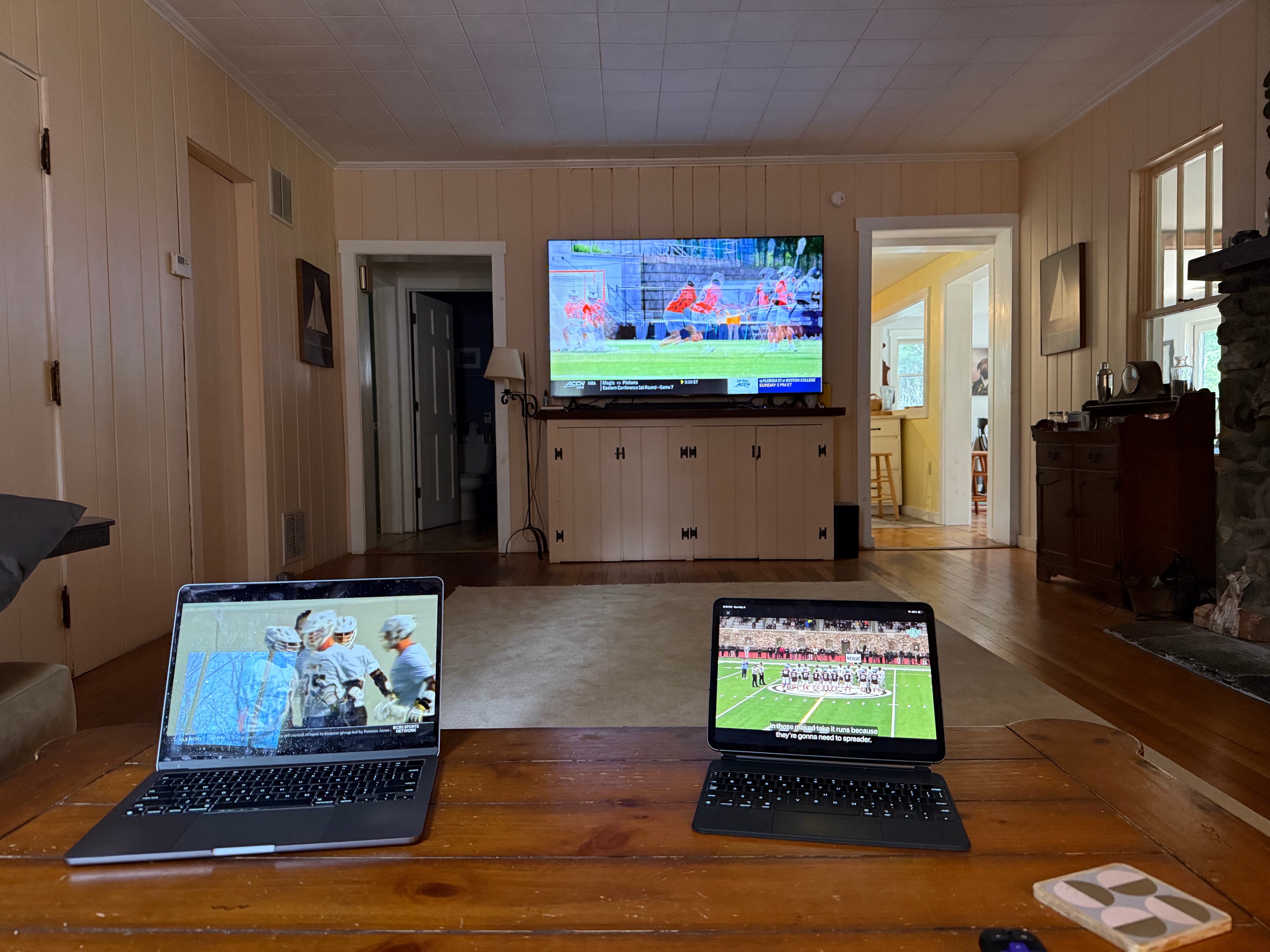
These are not good broadcasts. These are games shot from one fixed camera bolted somewhere near the concession stand, with wind noise, no commentary, and a score graphic that quit updating in the second quarter. Nobody watches these games. That is nearly literal — the viewer count is displayed, it is a two-digit number, and one of those digits is Ryan.
He knows the players’ names. Not the standouts. The names. He will tell you that the long pole for a school you have never heard of is a sophomore who is going to be a problem next spring, and he will turn out to be right, and there will be no practical way to confirm this, and nobody will ask.
Helena, asked to account for her husband’s whereabouts on a given evening, tends to answer in ranges.
“He’s at one of the five places,” she says. “It’s always one of the five places.”
THE TALENT PROBLEM
Here is the thing that keeps him up at night.
Hanover is not a poor town. Hanover has money. Hanover has parents who own three kinds of ski equipment and can name a nutritionist. Hanover has facilities, lights, turf, boosters, and a booster club newsletter with a header graphic. And yet, year after year, Hanover cannot field a team that scares anybody.
Ryan cannot understand it. He has thoughts. He shares them. He shares them in the parking lot, at the diner, in the group chat, and once, memorably, during a moment of silence.
What he does not do is connect any of this to the fact that his own kid — a kid who by every account can actually play, a kid who would be starting for this program right now — attends a prep school with a crest, a Latin motto, and a rowing team.
Asked about this, Ryan will explain that it was about academics.
Asked a follow-up, Ryan will notice something very interesting happening at the other end of the field.
THE GAME
His senior year, he played in the championship. He will tell you about it. You do not have to ask; asking is not part of the mechanism. The mechanism is simply time.
That was a quarter of a century ago. The account has not gotten any shorter.
He was a redhead then. Not strawberry. Not sandy. A full, unapologetic, structurally impressive red, the kind of hair that photographs badly and ages beautifully in the retelling. In the story it catches the light. In the story it is always the fourth quarter. In the story the crowd grows a little every year, which is remarkable, because the game was played in May in New Hampshire — a distinction without a difference — in front of maybe two hundred people, half of whom were sitting in the car with the engine running for the heat.
The hair is gone. He knows the hair is gone. He has made his peace with the hair being gone the way men do, which is to say not at all, silently, forever.
The game is not gone. The game is the whole reason. Every spring he stands on that sideline hoping some seventeen-year-old is about to get a version of the thing he got — one cold afternoon that lodges in a person for twenty-five years and refuses to be talked out of them.
THE VERDICT
Here is the unfortunate part, the part that ruins an otherwise perfect roast: he’s good at it, and he loves it, and those turn out to be the same fact.
Ten-plus years. Head coach, then not, then back again because he could not help himself. Unpaid or close enough to it. Cold May afternoons, rain, kids who don’t listen and parents who sometimes do — and he keeps showing up, waddling out of a home office to go stand in the wind and care enormously about a game that stopped owing him anything twenty-five years ago.
Nobody does that by accident. Nobody does that on the way to something better. He quit once and it didn’t take, and the sad, disqualifying, deeply unfunny truth is that Hanover is lucky to have him.
Somewhere in the Upper Valley tonight, it’s Miller Time.
The man earned it.
The author would like to note that he has ridden the bus. Repeatedly. It’s fine.
@Tyler Gardner